Slop Gorge: how uncanny valley applies to LLM output and how to course correct
I explore the slop gorge, an uncanny valley of text produced by LLMs

I’ll preface this post with the fact that I’m not an expert in the field when it comes to linguistics. I do, however, claim to have some passion in the field of computer science, code, and engineering management.
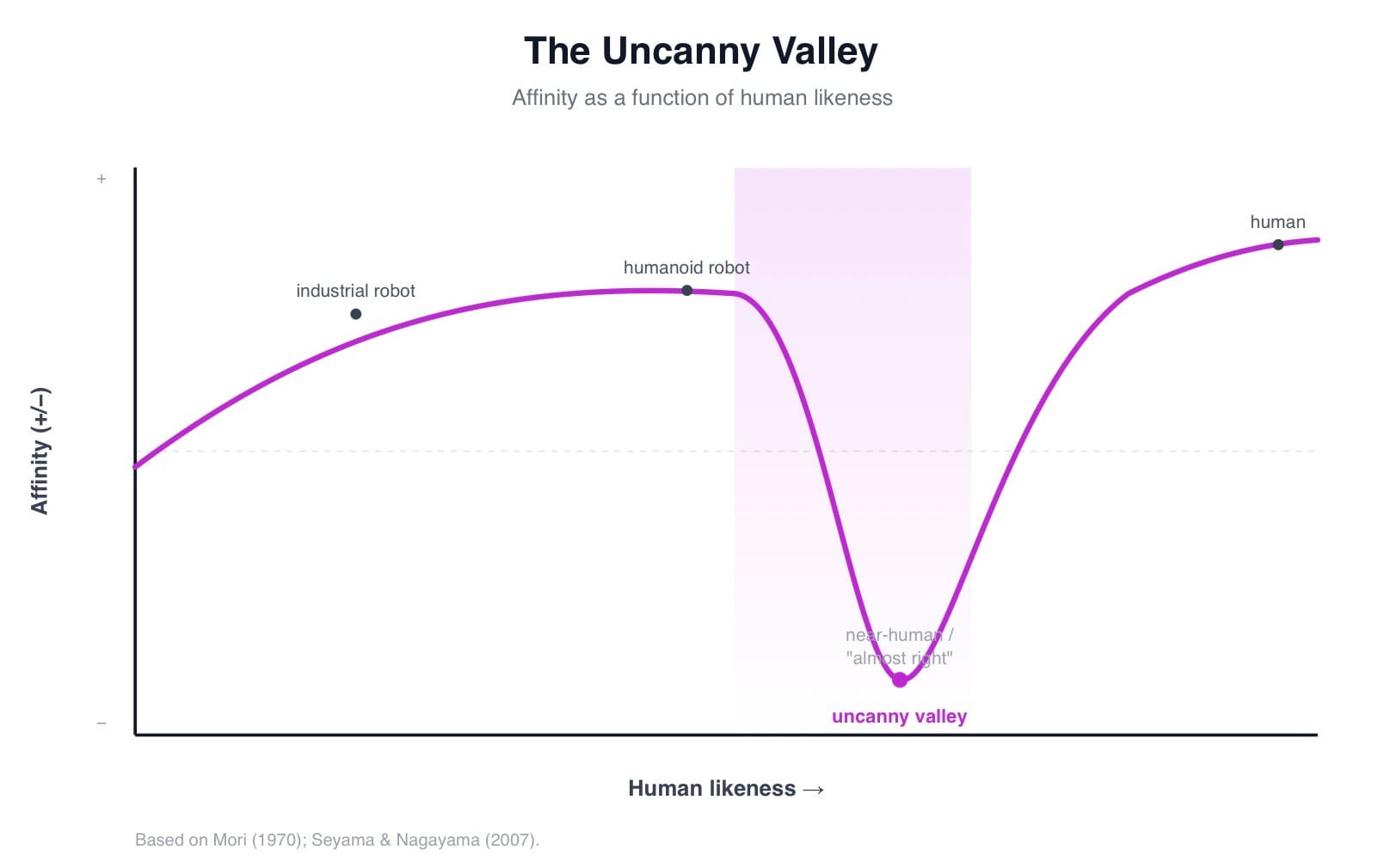
It’s probably worth explaining uncanny valley before moving much further in this essay. Uncanny valley is an observed and well documented phenomenon of human uneasiness toward CGI humans. The valley, pictured above, is the negative perception of an image that appears human like, but not perfectly realistic.
Remember the polar express movie? Unsettling right? That’s the valley. Do you get the same feeling from reading text, though?
I commit to writing every sentence by hand in my articles, because writing is more than a means of communication—it is an outlet, a craft, and a way of leaving an impression of myself on the world. I want my words to carry my voice, my perspective, and my imperfections. I refuse to outsource the act of thinking to a machine when the act of thinking is the point. Every sentence should be something I chose, shaped, and stood behind.
Except for that last paragraph. Could you tell? This was the original: I commit to writing every sentence by hand in my articles, because writing is an outlet, craft, and impression of myself onto the world.
For some reason, I can tell, and it’s not just my shitty grammar or lack of em dashes. First, is my style. When I’m in a writing mood, I have a certain tendency to write for lengths of time, which will cement a type of style in the context of a particular topic. How I’m feeling, what I’m thinking, how passionate I am about a particular topic will help form a specific style even within discrete paragraphs.
This essay, and many other passages of text also follow rough outlines from the brains that thought of them. For example this essay is planned to be: intro, uncanny valley, example (You’re here), tying them together, theories and mitigations, an AI snippet that might help. We’ll get to this a little bit later.
LLMs are incredibly useful tools, but at their base implementation, they are sentence predictors. They predict what sentence might satisfy the output the best for the input supplied. This means they are weaving together many trillions of training set materials into every response. This can also mean they don’t always nail style, ordering, & sentiment.
I recently sent out 28 handwritten messages to people who helped, sponsored, or connected deeply at the bigskydevconf.com conference. Why did I hand write them? Because I needed to directly translate my sentiment into messages.
That said, I use LLMs every day. They are deeply intertwined with my work and my life. At the crossroads of the human, and the LLM, is text.
Let’s talk about slop gorge. Slop gorge is the LLM output equivalent of uncanny valley. You look at text and can tell it’s AI generated: that’s slop gorge. It’s unsettling. It’s a time waste. Somewhere on the fence? That’s somewhere in slop gorge (maybe even human slop). Slop gorge is a strong indicator of ineffective text.
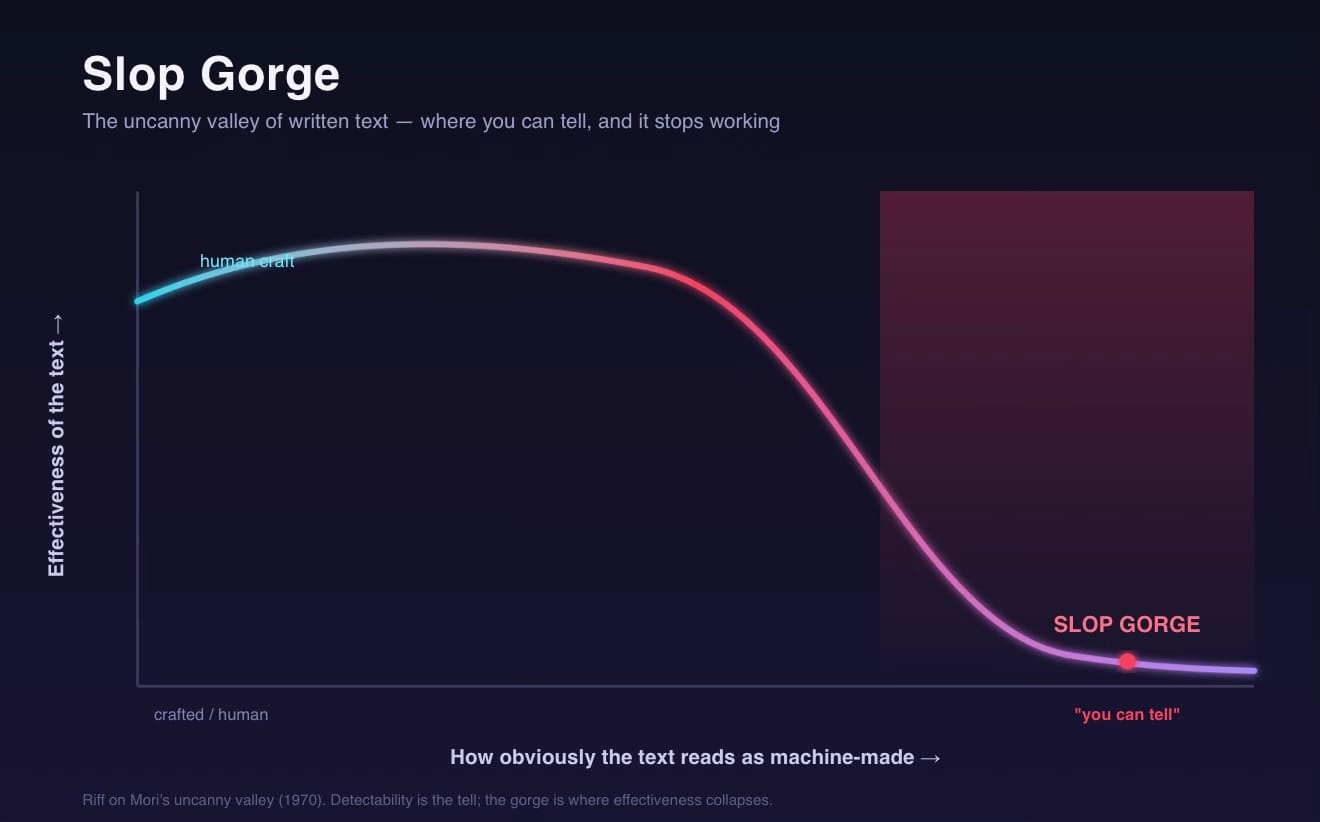
We already know that perception of text dives when a person knows content is AI generated. (Nakano, H., Takezawa, J., Matulic, F., Yang, C.-L., & Yatani, K. (2026). Understanding reader perception shifts upon disclosure of AI authorship [Paper accepted at IUI ’26]. arXiv. https://arxiv.org/abs/2510.24011)
What makes text enter slop gorge
I read a lot of LLM generated text these days and I have a few different observations about why text enters the slop gorge:
- Length
- Style
- Direction
- Purpose
- Bumps
Length
Specifically the length of content communicating a singular idea. If there’s a ton of extra fluff, a mountain of text, or a single idea rephrased in many different ways, I’d add a point for slop gorge.
Style
We talked about this one, but basically if the text follows a cohesive style that both mirrors the intended author, and meshes well in existing text. Does the text have the same vocabulary throughout? Consistency plays a big part here.
Direction & purpose
All text points at something. If it’s unclear in what direction the text points, it enters slop gorge. What do I mean? I mean: does the text in question state the purpose or meaning up front, or does it beat around the bush? Does it give reasoning in a clear and succinct manner, or does it provide meaningless fluff? Does the text follow a clear structure?
Bumps
This one is a broad category but includes things like em dashes, long lists of items, vocabulary that seems out of place, jargon, filler words, catchphrases (“belt and suspenders”), out of place idioms.
So, if AI does produce slop gorge content, how can you prevent it? It’s unlikely that you can. LLMs are trained with tons of prose. They have a bias to generate. They have a bias to produce something, even when something may not be the right answer. That said, I tried to hone this article into an editing prompt/skill you can definitely just snag from below.
This skill snippet isn’t special, there are plenty of other snippets like caveman, & attention span for example.
Thanks for reading!
Editing prompt: keep it out of the slop gorge
You’re helping me revise text so it reads as clearly human-written and effective. Apply these checks and fix what fails:
Length. Cut fluff. One idea gets stated once, not rephrased three ways. If a paragraph restates a point already made, delete it. Prefer the shorter version of any sentence that loses nothing.
Style. Match my voice and keep it consistent throughout: same vocabulary register, same rhythm, no drift into generic explainer-speak. If you have samples of my writing, mirror them. Don’t smooth everything into uniform, evenly-weighted sentences.
Direction & purpose. State the point up front, not after a windup. No beating around the bush, no throat-clearing intros. Every paragraph should clearly point at something; if I can’t tell what a passage is for, flag it.
Bumps. Remove the tells: em dashes, needless bulleted lists where prose would do, out-of-place jargon, filler words, catchphrases (“belt and suspenders,” “wholesale solution”), forced idioms, and vocabulary that doesn’t fit the surrounding text.
Don’t rewrite into a different voice. Preserve my structure and intent, and make the smallest changes that fix the problems. When you change something non-obvious, tell me what and why so I can push back.